Thursday, May 18, 2023

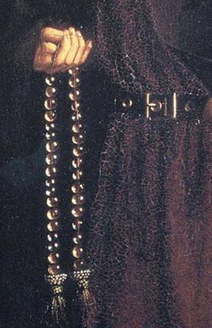
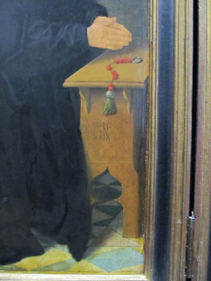
Reproduction of a Paternoster – Medieval Rosary


What? Paternoster with glass beads.

Where? Many European countries such as France, Denmark, Germany, Italy etc.

When? 1400’s

Why? I chose this paternoster as there were many images showing the similar details in the piece. As well as extant pieces found, it is easy enough to recreate one in an authentic manner based on the amount of collaborating evidence. This was made for the Politarchopolis Valentines event in February.

My Version:


I have since updated this paternoster to red silk tassels and replaced two white beads with another two white beads without impurities and a more uniform shape. 

Images of various pieces: 

Figure 1- Rogier van der Weyden The Magdalen Reading


Figure 2- Die Anbetung des Lamm Gottes Jan & Hubert van Eyck, 1432


Figure 3- Lochner, Stefan - Outside of an Altar Wing - 1445-1450


Figure 4- Martyrium der Hl. Ursula 1448


Figure 5- The Birth of Christi, Gerard Davis, 1495


Materials and techniques:

-Glass (glass beads)

-Technique: lampwork techniques to recreate a similar shape and size in each bead.

String: Corded strings with tassels can be seen in most of the art.


Details of the Recreation: 

I chose to recreate the number of glass beads that can be seen on a number of the images that I have collected. The beads are simple, in one or two standard colors. They are unadorned, keeping the piety of decoration that was common at the time. 

Working with Glass:

I have been working on developing my skill at melting glass and shaping it over the last couple of years. I have learnt a lot, including where in the flame certain glass must be placed so that it doesn’t ruin the colour or texture. I have learnt how to steadily place my hands and rotate both glass and mandrel so that an even amount of glass, at the right temperature, is kept at the right heat to reproduce the desired bead.

The necklace presented a variety of challenges. Glass is a dangerous, sometimes fickle substance, and certain colours only work properly at a certain heat.

Some of the trickier techniques (and melting glass onto a mandrel and keeping it even is tricky to start with!) that I used for this project include:

·         Studying each (photo of) bead in a variety of lights to get an accurate grasp of the details.

·         Working with tricky colours.

·         Combining colours and the perfect melt down spot to get a more accurate shade and shape.

·         Shaping similar size beads


Details of the equipment and resources:


·         I used a graphite paddle, mandrels, bead release, a knife, fire annealing and gravity. I try to use the least tools possible and authentic equipment that would have been used by the glassmakers of the time. Apart from my fire set-up, all the equipment I have used would have been used at the time as well.

·         Clear broken glass was often used as well as imported blocks of coloured glass. (Regia Anglorum)

·         The glass rods I used to recreate these beads were Effetre Murano – 104 COE soft glass rods. This is a close replica of the glass that would have been used at the time.

·         Bead artisans would have created a small kiln or furnace. The broken recycled glass would be put into the furnace through holes in the side to melt in a dish inside the furnace. Air was pumped into the furnace to keep the charcoal hot. (Guido)

·         I use a hot head torch and MAPP gas. In the future I have plans to recreate a small portable kiln but melting glass in a small kiln is very difficult as getting the heat hot enough to melt the glass is a struggle.

·         Metal rods (mandrels) were dipped with a clay mixture called bead release. The molten glass is wound onto the rod until the desired shape was achieved. Once the bead size and shape were achieved, a design could be added by heating thin bits of glass and wrapping them around the bead, with a “stringer” that was heated and laid on top. (Guido)

·         I use mandrels that would have been very similar to those used, however, mine are shorter as they don’t need to be as long to reach into a hot fire. The bead release I use has the crucial ingredients of water, kaolin and alumina hydrate, which is a composition that would have been used.

·         Beads would then be moved to an annealing dish in the furnace. This would prevent thermal shock, lowering the chances of the bead cracking.

·         Instead of annealing them in a furnace, I use a product called vermiculite to allow the beads to cool down slowly. I also use a kiln. In the future, I would like to try annealing them in a furnace to see what it is like.

·         After the beads are finished, I remove them from the mandrels, clean them out with some bead cleaning tools and give them a quick clean with some soapy water.

·         I included a selection of creative beads using the resources that would have been available to make this necklace. As you can see, the original colour layout is more striking in colour.


Future Projects:


·         In the future, I would like to continue to practice more difficult skills, e.g., fine line work, millefiori use and making the Chinese Warring state Beads which had over 100 steps each.

·         I am enjoying creating pieces from different times and cultures and I will continue to develop my skills by continuing to choose challenging projects.

·         I also enjoyed working with the museum and the professor when I recreated a 133 bead Phoenician necklace, and I would like to continue working with people like this. Not only was it very educational and rewarding, but it resulted in me contributing to the historical accuracy of the museum- which I thought was cool!

·         I also intend to work on another historical recreation of a glass making set up.


Secondary Resources: 

Guido, Margaret. The Glass Beads of Anglo-Saxon England: c. AD 400-700, Boydell Press, 1999.

Holgate, Barbara.  “The Pagan Lady of Peel”, St. Patrick’s Isle Archaeological Trust, 1987. 

Regia Anglorum: https://regia.org/

Thursday, April 20, 2023

Latvian Glass Beads

Historical Notes


- The coils/spirals/wire weaving are much easier to document for this time period and location, however there is some evidence of glass work in the region and time.
- Keep in mind that glass beads in particular were a highly valued trade commodity and have been found across time periods and cultures, particularly annular beads, evil eye beads and round beads.
- In 2015, 200 burial mounds were discovered and looted- robbing the Latvian landscape of significant cultural knowledge and artifacts.
- Anna Zarina was a leading expert in the clothing and decorations of the ancient Latgallians.
- After World War I, the new sovereign states that emerged on the east coast of the Baltic Sea – Estonia, Latvia, Lithuania, and Finland – became known as the Baltic states.


Latvia

Finno Ugrian: Findspot; Latvia, Aizkraukle/Sigulda


Gold in Glass beads- Latvian finds

General

Lithuania
  • Anna Zariņa. Salaspils Laukskolas kapulauks. 10.-13. gadsimts. 350. lp

Misc:


Ancient Chinese Paintings

Chinese Paintings- Research starts


  • Look at particular famous ones, and follow up the information on the extant piece. 

  • What did they use? 

  • What was the style? 

  • Why did they make the choices they did? 

Eg: 

The Nymph of the Luo River – Gu Kaizhi. The Nymph of the Luo River, 10-13th century, handscroll, ink and colors on silk, Palace Museum, Beijing, China.

Image result for ancient chinese paintings


  • Local museums: 


  • Other museums:  


  • Research papers such as:


  • SCA resources such as: 


  • Pinterest: 


  • The period I have particularly researched is this one: 

  • Chinese Warring States Period. I have come across artworks such as this:

                        https://www.pinterest.com.au/pin/465700417734286934/ 


Thursday, March 30, 2023

Documentation: Reproduction of 14th century Islamic Glass Weights

Baroness Ginevra Lucia Di Namoraza
Figure 1


What? A selection of Islamic Glass Weights. The weights are small, round glass discs often with an impressed inscription of the name and title of the caliph or the name of the governor on them.[1]

Where? Egypt, Islamic countries
When? Popular through cultures and history but will be focussing on the 14th Century extant pieces from Egypt.
Figure 2


Why ? They are a unique piece with a very interesting history and function. They could be used in several useful ways within an SCA context including the use of them as personal tokens, as a fancy stamp
on scrolls or as game pieces. “Small glass discs with Arabic inscriptions present an important record of the early Islamic economic system as well as the organisation of the glass industry”[2]
Figure 3

Glass weights came in many sizes and denominations. They were regulated and used in medieval Egypt to measure many different items, from grains and olive oil to coins. Metal coins varied in weight and did not always contain
pure gold and silver. For these reasons, in market transactions the weight of precious metal coins would be measured on a balance against glass coins in order to determine a correct sum of money. Glass weights were thus not used as currency but as a means to weigh metal coins accurately. Moreover, their common use in commercial affairs is recorded in medieval letters written by merchants who used the Arabic verb "to weigh" (wazana) as a synonym for "to pay."
Figure 4
[3]

Details of the extant pieces: There are many centuries of wear on the glass that is on display. This means that colours and details are faded, and many of the weights have faults such as chips etc. The extant weights demonstrate the variety in size, shape, and inscriptions.


Details of the Recreation: 
Figure 5


Glass weights were made by impressing an inscribed stamp into a measured globule of glass while it was still in a semi-liquid state.[4] 

I chose to recreate a few the glass tokens that are on display in a variety of museums to ensure historical accuracy. 

I worked with each museum's high-resolution images to recreate the piece with their unique characteristics. 
Figure 6

I have then taken creative liberty with the stamps and made several of the glass weights ‘in the style of’. 

Some of these stamps I created by carving soapstone (the Lochac crest, the Islamic script) and engraving brass (the raven). 

These coins require precise movement of the glass, and patience and time melting it slowly and accurately so that the colour is not damaged and that the glass is melted carefully so that it isn’t stressed (it can fracture if so). 
Figure 7

Each coin takes 20 to 30 minutes to make, and if the press of the stamp isn’t clean enough, it must be remelted within a certain amount of time and redone, or the glass is more likely to crack or shatter. 

I have been working on developing my skill at melting glass and shaping it over the last year. I have learnt a lot, including where in the flame certain

glass must be placed so that it doesn’t ruin the colour or texture. 
Figure 8

I have learnt how to steadily place my hands and the glass to keep it at the right temperature. 

The coin weights presented a variety of challenges. Glass is a dangerous, sometimes fickle substance, and certain colours only work properly at a certain heat. 

Some of the trickier techniques that I used for this project include:


Pressing
Figure 9
the molten glass with a stamp with enough pressure to leave a mark. If this isn’t done at the precise correct timing though, the glass can become subtly too hard and slippery and the press can slip, risking burn injuries. (Ask me how I know!)
Studying each (photo of) bead in a variety of lights to get an accurate grasp of the details and finishes required.
Working with tricky colours such as white, light brown, and light blue which can be easy to “burn” or mutate colour.

Using techniques such as flattening the weights in a circular shape and then pressing carefully.

Figure 10
Details of the equipment and resources

I used a graphite paddle, a knife, fire annealing and gravity. I try to use the least tools possible and authentic equipment that would have been used by the glassmakers of the time. 

Apart from my fire set-up, all the equipment I have used would have been used at the time as well.

Figure 11
Glass artisans would have created a small kiln or furnace. The broken recycled glass would be put into the furnace through holes in the side to melt in a dish inside the furnace. Air was pumped into the furnace to keep the charcoal hot.[6]

I use a hot head torch and MAPP gas. In the future I have plans to recreate a small portable kiln but melting glass in a small kiln is very difficult as getting the heat hot enough to melt the glass is a struggle.


Figure 12
Glass would then be moved to an annealing dish in the furnace. This would prevent thermal shock, lowering the chances of the bead cracking.

Instead of annealing them in a furnace, I use a product called vermiculite to allow the glass to cool down slowly. I also use a kiln. In the future, I would like to try annealing them in a furnace to see what it is like.


Future Projects:


Figure 13
In the future, I would like to continue finding obscure glass items as they are quite interesting.

I would like to practice more difficult skills, e.g., larger sizes.  

For this project, I would match the weight more accurately, and the press form.

I am enjoying creating pieces from different times and cultures and I will

continue to develop my skills by choosing challenging projects.

I also enjoyed working with museums in previous projects, and I would like to continue working with

people like this. Not only was it very educational and rewarding, but it resulted in me contributing to

the historical accuracy of the museum- which I thought was cool!

I also intend to work on another historical recreation of a glass making set up.

Primary Resources: 

High-Resolution Copy of the extant beads. Can be found in Image credits.


Secondary Resources: 


  • Al-Gailani, Noorah. "Glass weight" in Discover Islamic Art, Museum With No Frontiers, 2023.
  • Bates, M.L. The function of fāṭimid and ayyūbid glass wėights. J. Econ. Soc. Hist. Orient/Journal de l'histoire economique et sociale de l'Orient 24, 63–92. 1981.
  • Guido, Margaret. The Glass Beads of Anglo-Saxon England: c. AD 400-700, Boydell Press, 1999.
  • Holgate, Barbara. “The Pagan Lady of Peel”, St. Patrick’s Isle Archaeological Trust, 1987.
  • Morton, A.C. Heavy Minerals in Provenance Studies. In: Zuffa, G.G., Ed., Provenance of Arenites, Reidel, Dordrecht, 249-277. 1985.
  • Regia Anglorum: https://regia.org/
  • Schibille, Gratuze, Ollivier, Blondeau. Chronology of early Islamic glass compositions from Egypt. Journal of Archaeological Science, 104, pp.10-18. 2019


Image credits

Websites     


[1] Bates 1993

[2] Al-Gailani 2023

[3] Al-Gailani 2023

[4] Morton 1985

[5] Regia Anglorum

[6] Guido


Further Research/ Evidence:

  • https://art.thewalters.org/detail/25429/menorah-token-2/
  • https://art.thewalters.org/detail/11026/inscribed-pound-weight/
  • https://art.thewalters.org/detail/14979/deesis-2/